Home
›
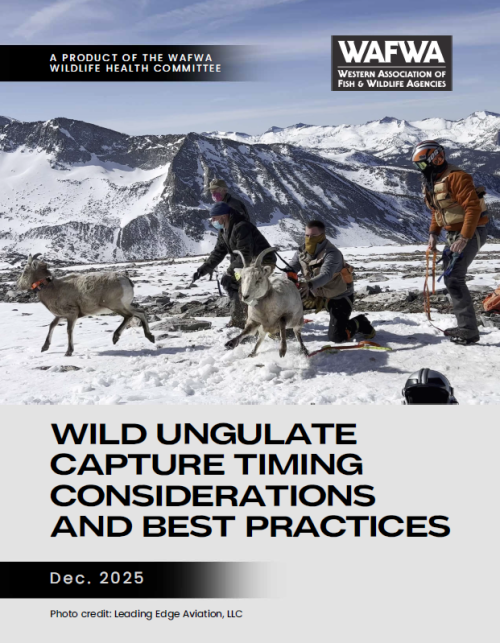
Ungulate Capture Timing Considerations and Best Practices
Posted by WAFWA on January 27, 2026
When planning ungulate captures, wildlife professionals must consider both the animals and the complex systems in which they live, in addition to logistical and financial challenges. The species, age, reproductive status, time of year, reason for capture, habitat, weather, terrain, and available resources all affect capture outcomes. The available…
Read More
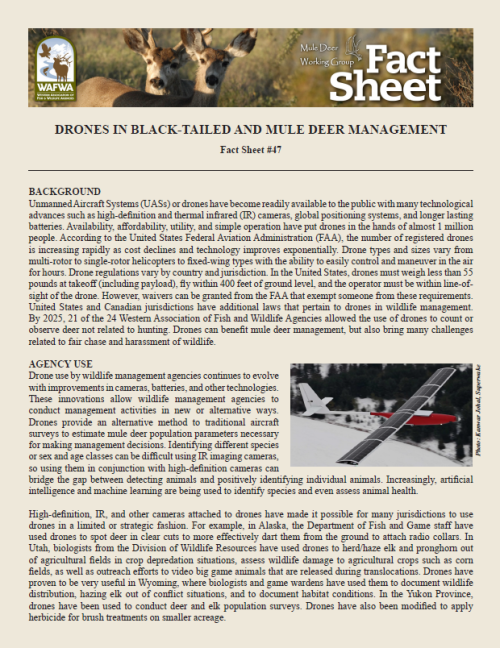
DRONES IN BLACK-TAILED AND MULE DEER MANAGEMENT
Posted by WAFWA on January 5, 2026
BACKGROUND Unmanned Aircraft Systems (UASs) or drones have become readily available to the public with many technological advances such as high-definition and thermal infrared (IR) cameras, global positioning systems, and longer lasting batteries. Availability, affordability, utility, and simple operation have put drones in the hands of almost 1 million…
Read More
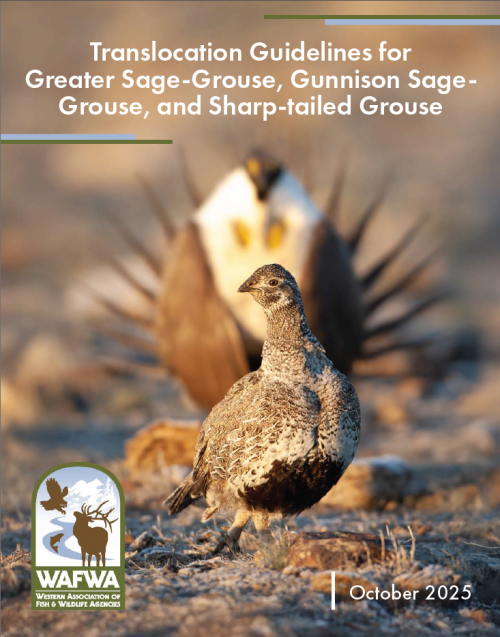
Translocation Guidelines for Greater Sage-Grouse, Gunnison Sage-Grouse, and Sharp-tailed Grouse
Posted by WAFWA on October 1, 2025
Restoration of grouse populations using conservation translocation (hereafter; translocation), the movement of wild animals from one location to another, has become a fundamental component of grouse conservation and management. Translocation is especially important in western North America, as conservation concerns for greater sage-grouse (Centrocercus urophasianus), Gunnison sage-grouse (Centrocercus minimus), and sharp-tailed grouse (Tympanuchus phasianellus) have increased. At the Western Association of Fish and Wildlife Agencies (WAFWA) annual winter meeting on 9 January 2005, agency directors agreed “to develop standards, prioritize projects for translocation and identify appropriate source populations for these translocation projects based upon appropriate scientific principles.” This has been a lengthy collaborative process that has involved numerous research projects, extensive literature review, and development of translocation methods and protocols. This document is a compilation of the results of that effort.
Read More