Partners in Action: Montana Grassland Initiative
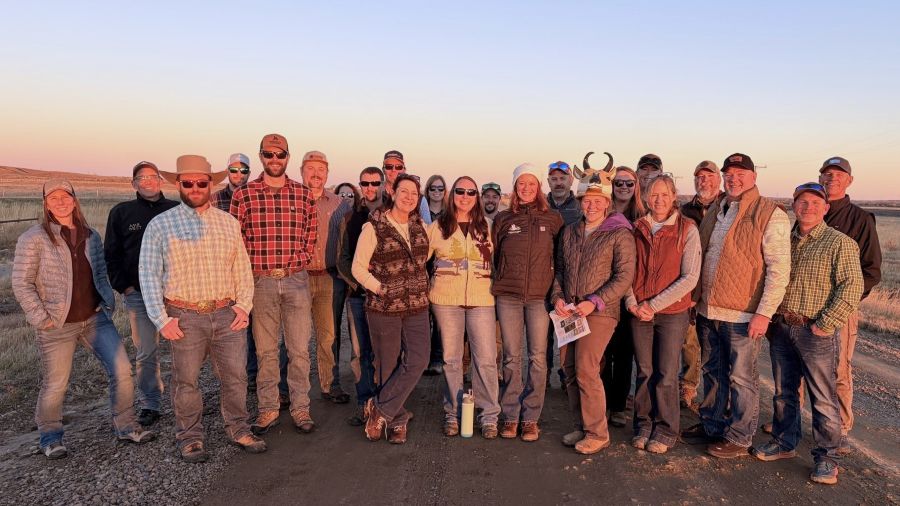
In mid-November, Pheasants Forever Montana Grasslands Initiative partners hosted a field tour of projects improving grasslands, sagebrush, and wildlife movement along the “Hi-Line” of Montana above the Missouri River. WAFWA’s Sagebrush Conservation Initiative and Western Working Lands Coordinator, Tim Griffiths, participated in the field tour that showcased the tremendous outcomes achieved in the region so far.
According to the Montana Grasslands Initiative website, “Grasslands and Sagebrush steppe are vital to the Montana upland experience — as well as to the state’s culture, industry and wildlife. These crucial pieces of Montana’s legacy are disappearing at an alarming rate. Over 30% of eastern Montana’s grasslands have been broken or altered, and the state has seen a 34% decline in grassland bird populations. Over 1.5 million Montana acres enrolled in the Conservation Reserve Program (CRP) have expired in the last decade — and nationwide, 2.6 million acres of grasslands are lost every year.”
At its core, the Montana Grasslands Initiative is anchored around two Regional Conservation Partnership Program agreements between the Natural Resources Conservation Service (NRCS) and Pheasants Forever/Quail Forever (PF/QF) totaling $31.6 million in on-the-ground conservation dollars. This foundational support is highly leveraged by contributions from a broad network of partners, multiplying impact across the landscape.
Importantly, this partnership is focused on conserving “working lands” where both ag and wildlife interests are addressed. As a result of this win-win approach, massive and ever-growing support from a diverse array of partners for the community is achieved. Major partners of PF/QF include Montana Fish, Wildlife & Parks along with the Bureau of Land Management, NRCS, U.S. Fish and Wildlife Service, Ducks Unlimited, Joint Ventures, Montana Conservation Corps, Rancher Stewardship Alliance, Winnett ACES, World Wildlife Fund, Arthur Blank Foundation, and more.
Partners here identify priority areas, implement conservation measures seamlessly across public/private boundaries, and scale these efforts across the entire region. Resulting outcomes include resilient large and intact grass- and shrub-lands that provide forage for family run livestock enterprises, support world class habitats for unique grassland-dependent wildlife such as Sprague’s pipit and greater sage grouse, and maintain iconic migrations of western big game species such as pronghorn and mule deer.
Progress for the Montana Grasslands Initiative to date includes anchoring 352,366 intact acres, enhancing 401,644 acres, restoring 54,491 acres of converted grassland, and opening 12,712 acres for new public access. In total so far, the partners have impacted 822,413 acres of grassland, just over half of the initiative’s 1.55 million acre 5-year goal.
Projects like the Montana Grasslands Initiative tie directly into the work that WAFWA is doing with its strategic initiatives, including the Sagebrush Conservation, Western Grasslands, and Wildlife Movement & Connectivity Initiatives.
“This effort is a tangible example of how a single partnership is contributing to the broader west-wide priorities outlined through various WAFWA initiatives,” Griffiths commented. “Hats off to all the outstanding partners in Montana making this work possible. WAFWA staff appreciated the opportunity to participate in the field tour and witnessed firsthand the success of this partnership.”

Comments (0)